Translate

4/27/2013

Hockey Night in Abu Dhabi: Spotlight on an Emirati Hockey Queen

*updated with a documentary film made about Fatima, who is also the first Emirati female sports photographer! Against the Wind documentary

A few months ago I realized a former female student of mine played hockey - like a lot! All winter (well, winter is a relative term here in Abu Dhabi) I have been planning and meaning to go to one of her games and something always got in the way...

But tonight no! I made it to the Abu Dhabi Storm's game against a Dubai women's team. The Storm's are an all but three Emirati ladies team - and they played hard against a team made up of new players (like Fatima) and women who love the game (and they pay for their own ice time!). It was an interesting game to watch - but the best part was talking with Fatima after.

Yes, there is an ice rink in Abu Dhabi and it is well used!
The Abu Dhabi Storm were formed in 2010 and from the beginning, because of a love of hockey, Fatima has been the official team photographer. After much encouragement from her second family she laced on her skates and joined the team in May 2011 and started learning how to play hockey! Of course, now she says hockey is her life - and truly, it is... (I introduced her to the term rink rat!)


Lots of passes and shots

Abu Dhabi Storm in the white and pink!

The Dubai team scores!

Fatima is number 7 and plays centre (and the wings)

Team gathering after the final whistle

Good game ladies!
Fatima Al Ali - Emirati hockey queen!


After only two years of playing hockey Fatima is on the first line, coaches the second string men's team, has played on the men's team (only woman and only one of two Emiratis) and has learned how to referee and does it on a regular basis.

She is well supported by her family, and tonight her Mom, brothers and cousins were there to cheer her on. She said "I enjoy playing hockey and I can't imagine my life without playing.".

I taught Fatima in Introduction to Management a few years ago and she graduated in Management and Information Systems last year. Three of the ladies on the team are currently students at Zayed University - but I don't have the pleasure of teaching them.

Fatima is super serious about hockey, she has been to training camps overseas and four international tournaments (two with the men's team) and leaves this Saturday for a fifth in Hong Kong.

In a year or so hopefully there will be a women's National team - and Fatima's dream is to be the Captain and she has a plan to get there! Her goal is to be the best player on the team and always improve her skills and her game.

I hope one day I will be able to take her to a game in Canada to watch her favorite player - Alexander Ovechkin or even better, her second and third favorit players on the Vancouver Canucks!

Bravo Fatima - you break every stereotype and do it as the most natural thing in the world - I am super proud of you - and one day, when you are team captain of the National Team I will want an autographed team photo!

4/26/2013

One year of blogging - top five lessons learned

So, in a few days I will have been blogging for a year. Promoting my blog through social media and getting feedback from around the world. All in all a totally positive experience that lets me share my experiences and projects with my awesome students, my research and my collaborations with other great professors and students.

I have learned a few things along the way, which in fact have improved my teaching to some extent, as I have become more understanding of the need to express some things visually. Now i encourage students to incorporate photos and videos to support their written projects - to make the project more interesting for the students, but also to inspire them to think in different ways.

Here are a few things I have learned in the past year of blogging - in list form:

  1. People like lists - seriously, I do not use them enough, but the times I have done those posts get more views
  2. People like photos - and I swear some people don't really read my fine words, but just look at the pictures - I am fine with that now!
  3. Disseminating research to the outside world is hard - but I will never give up trying new ways and new methods
  4. Students research projects on blogs - I am sure some of my models have ended up in assignments from India to Germany and beyond!
  5. I love when people read my work - the visitor count makes me happy and the country count makes me constantly wonder at the power of the internet.
I will continue to blog, even after I leave the UAE. This summer I will be driving the Alaska Highway with my Mom and Dad and will start a blog shortly about our planning process and then write daily posts about the trip (need to buy a new phone with a better camera). I have my smile and courage blog and adventures of Auntie as well. 

I guess blogging is in my blood now!
Most common view when writing my blog posts! (Except it is usually sunny)


4/19/2013

Strategy class trip to Emirati family photograph art exhibit

Yesterday I took both my men's Strategy classes to an photography exhibit developed and organised by the College of Art and Creative Enterprises at Zayed University in Abu Dhabi. You can read The National's story on it here.


The exhibit displayed what was first a very creative assignment given by Dr.Michele Bambling who invited students to bring in family photographs and over the past three years it grew until there was almost no choice but to do an exhibit. The book (which is truly stunning) was designed by David Howarth, an Assistant Professor of Graphic Design. In the words of Marco Sosa, who designed the show:

"This is the first exhibition and accompanying book that examines family photographs produced by Emiratis during the second half of the 20th century.

The photographs and video footage in this exhibition differ dramatically from better known and widely distributed professional photos taken by early explorers, missionaries, oil companies, government agencies, the media, and royal family photographers. These are snapshots focused not on official events or protocol, by virtue of being taken by amateurs; they are candid, clicked for private viewing and lasting memories.

The exhibition begins by showing the process through which students collected, researched, curated and authored a book of photographs. The oldest photograph found in a home was dated 1958; the most recent one was made in 1999, after which the students could ‘see’ the world into which world they were born.


The second part of the exhibition explores student responses to these photographs through a series of experimental installations that draw on them with an aesthetic sensibility of their own generation.

These inter-generational works consider a critical issue: the capacity of photography to evoke memories and stir the imagination."

But why take my "strategy boys" there? What interest do they have in art? Or taking the long outside trek to the exhibit space on the exact other side of the campus from our class? Because, as I have written about before, their first assignment is an essay on the subject "Strategy is..." based on an interview with an Emirati older than 60 years young. You can read a post about the assignment here and some results here.

I wanted them to be inspired by the photographs themselves to remember family stories, legends and other oral history that teaches about how people reached their personal and professional goals - about the strategies they used and the tactics they employed.

The students found it interesting, some were very keen to learn more about ways to celebrate and preserve heritage and culture and that was exciting to all the professors there (thank you Marco, David and Michele for volunteering your time for the tour!). We also used the Polaroid camera to fill the map of visitors to the exhibit... 

Teaching "business" subjects is not about just using techniques invented by old (white, sorry but true) men in the 50s and 60s. Teaching strategy, management and human resource management can be done in any number of ways - and to be relevant to today's generations, and especially to be relevant to Emirati students we need to find ways to teach that are relevant to them - not people who lived in another era and century! 

Mr. Marco explaining the exhibit and the heavily student involved process

Dr. Michelle, Mr. David and Mr. Marco

Trying out the old typewriters and looking at the book

A student from Ajman being photographed for the map

And I live about here! Using google maps to pinpoint exact location!

4/08/2013

Entrepreneurship and employment clubs: needed here and abroad

I just spent the most remarkable and memorable ten days in Rwanda. I was there to visit a beautiful country that is still healing from a genocide 19 years ago that killed over one million Tutsis and left thousands of orphans. I was also there to witness the graduation of my foster daughter Berthe, who had survived the genocide with her younger brother but who lost her father, mother and elder sisters and brothers.

The link to our story is here http://allafrica.com/stories/201304080020.html. I supported Berthe studies in Rwanda and she has graduated with a degree in International Development and wrote her thesis on recycling waste. I am extremely proud of her - and want her to build a life and a family for herself and help to continue to build her country.

Berthe is still looking for work though, as were most of the 22 students our charity Ibuka Education supported. They have overcome great personal and societal defeats to obtain degrees in Accounting and Sociology and International Development, but like more than 25% of young educated people in the Middle East North Africa and Africa they are jobless - and many are hopeless of ever finding work.

Some graduating students from Ibuka Education

As we drove around Kigali I would look at the names on buildings and the names on the "fancy" cars and I saw Government and NGOs - very few private companies in fact. I did see enterprising young people washing cars and delivering fruits and vegetables - and even running vegetable stands - but I saw very few thinking of starting their own company or working in a young company.

Most of the students wanted to work with government or NGOs (which are run like semi-government organisations) and of course that reminded me of my students here in Abu Dhabi. Then I remember myself when I graduated with a degree in history... and well, I guess I wanted to work for government too (and as a professor I guess I will always work for government in one way or another!).

I saw though that government jobs are saturated, NGOs hire the best and brightest, but many/most come from other countries and there is little "local capacity development" which could be possible with internships (again, this is only what I saw). What can these bright young students do - who fear failure not because life has been too easy, but perhaps because life has been too hard.

Speaking with them I felt hopeless - as a large collective we had supported them in their studies and now they graduate with few opportunities. So I thought, well, they could start a club - call it the Employment and Entrepreneurship Club. They could write up a simple charter, elect/select an executive and members at large and write up their goals.

Then, they will need to organize their first event - I told them I would sponsor it and I truly hope they take me up on it. They could invite someone they admire, a business woman or man, to talk about how they started. They could knock on some doors to find a venue (with a written proposal that many wonderful people in Kigali would help them with), perhaps contact a newspaper to cover the event and just do it.

Each month they could organize an event, and hold weekly meeting to talk about job opportunities and free networking events they could attend. They could have CV writing workshops and interview practices... but at the end of the day it has to be organised by them for them. Yes, these clubs and events are held everywhere in the West... but I think it is in the developing world we need them most.

NGOs serve a great purpose of course, but there needs to be more focus on local capacity development through sponsoring such grass roots clubs... through help with writing press releases, finding venues, looking for local sponsors...

I hope the fresh graduates take me up on the challenge and use the Canada notebooks I gave them - one to write dreams and the other to write actions. We never reach our dreams in one days and the path to achieve them is rarely (if ever) straight and narrow... but if we do something each day or each week eventually there is an accumulation of effort that actually amounts to something.

I wish them luck and I hope they know how proud I am, how proud the over 100 foster parents are of them from Canada, Europe, the US and Rwanda... Bravo!

3/20/2013

The Water Supply Game: Teaching Supply Chain Dynamics to Emirati Students


This past Monday the Student Life Committee of the College of Business (surprise, I am Co-Chair) organised a campus swap for our female students. Professors Claire Sherman, Taiba Hussain, Catherine Budd, Marc Poulin (fellow former U Laval and CIRRELT alumnus)  and myself organised for some of our Abu Dhabi students to visit our Dubai campus.(Now, for my readers in Canada I can explain the Abu Dhabi vs. Dubai feeling as Victoria to Vancouver and Quebec City to Montreal).

It was a lot of fun - and although things did not go exactly as planned, the young ladies met and got to know one another and saw how things are done in the same University, same country, just different campuses. The highlight of the day for me was playing the "water game" with the students. What is the "water game" you ask? Well, let me explain through words and photos (and a link to an academic article only hard core nerds will click on).

So first - water game? Well, the game originated as the Beer Game in MIT in the 1960s to teach supply chain dynamics and the bullwhip effect, the Research Consortium I worked for at Laval adapted the game for the Canadian forest products industry - you can play the game here online (it is super fun, available in French and English and yes, if you email I am sure Phillip Marier will help you out with presentations and the like).

I have played the Wood Supply Game countless times, as a transfer tool with managers, with students, with colleagues, in competition, and just for fun.  and Phillip and I wrote an article about the game in 2004 (yes, I was a nerd even before I got a PhD) - that article is available here.

As obviously the Beer Game is out as a concept, and for that matter the forest products industry is pretty foreign and exotic here - so Marc (an operations professor extraordinaire) decided to adapt the game to the local environment and call it the water game. Using and adapting some great open source material online here is the story of our experiment in learning!

While the students were on the tour, Catherine, Marc and I set up the playing table. I was in charge of photography :)
Marc and Catherine setting up the game
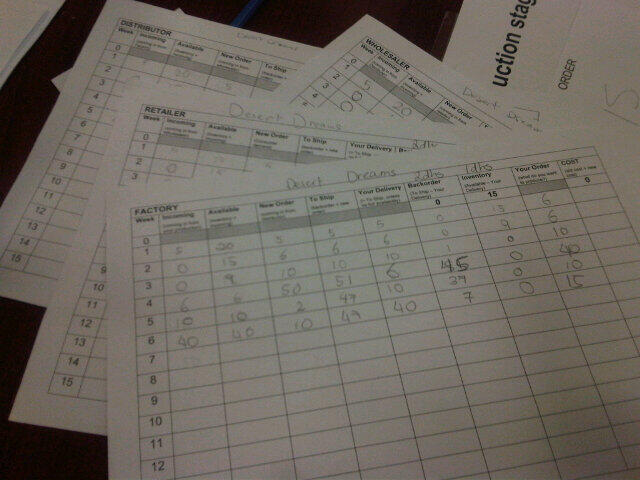
There are four positions per "supply chain" - Factory, Distributor, Wholesaler and Retail. Each "company" has information exchange on the "top sheets of paper"  and goods exchange on the "bottom sheets of paper". Of course, one of the first things we learn when we live supply chain dynamics (e.g. waiting for an out of stock item) is that information and goods travel in different directions and at different speeds!

When the ladies got back from lunch, Marc explained the game. Of course, until we start playing it is hard to conceptualize what to do - so we started week by week, step by step. What ensued was frustration, many laughs, confusion, light bulb moments, and yes, even fun!

Listening to the rules of the game
We named each "supply chain" and ended up playing 6 rounds or weeks. Really the game requires more time, but my goodness I had fun (and I took over the factory position in one sc when two ladies needed to leave).

Arabian nights results

Desert dreams result

Honestly, I cannot remember the team which won - and it is based on inventory (1 dhs) and back order (2 dhs) costs - but really, the game needs to be played for about 30 or 40 rounds for all the information and decisions to work themselves through the system.

Marc compiling results in an excel sheet he had prepared

This was just a first experiment teaching and playing the game here and it would be wonderful to play it in the future with about 4 - 6 hours. Really though, it might have been "harder than the test I took last week" as one student said, to learn the initial dynamics, but the learning curve is steep when we are doing and learning at the same time.

End of the game, certificates and participation gifts!


3/16/2013

Low levels of technology in start-ups in the UAE


This post provides data and a condensed exert from the GEM UAE 2011 Report and is copyrighted material of the authors of the report. It can be downloaded here: UAE 2011 GEM Report If you would like to quote the report or this blog post please use the following details: 

Van Horne, C., Huang, V., and Al Awad, M. 2012. “UAE GEM Report 2011”, Zayed University, UAE


As a researcher in innovation processes I have seen the spark of an initial idea, seen it work its way through research and development, testing through simulation, prototypes, beta testing and then finally on to the final product being used by the end consumer.

In a knowledge economy, technology and the birth of new firms from technology driven innovative ideas and services, need to be nurtured and encouraged. In a small market knowledge economy, innovation and technology are key to increasing exports and the sale of intellectual property.

Using data from 2011 - the UAE GEM Report has found that almost all new business started in the UAE in 2011 have no or low technological levels, with only 2.3% being medium-tech or high-tech new ventures (Figure 1). when figures for Emirati entrepreneurs the figures are even more shocking - 100% of new businesses are no/low tech.

 Level of  technology in UAE start-ups 2011
Perhaps worse is that these figures have not changes since the GEM Report was first published in 2006. In comparison with other innovation-driven economies, the UAE has the second lowest rate of medium technology to high technology established businesses at 2.3% compared to the lowest performing country, Czech Republic at 1.3% and the best performing country, Norway at 14.3%.

As the aerospace and advanced manufacturing industries develop and expand in the UAE this should promote the start-up of high tech small firms. Perhaps targeted initiatives could be developed to promote young people to start up high-tech businesses in their "garages" - perhaps through developing applications, games and other products I am unfamiliar with as a middle-aged professor!

This semester I have a group of male students looking at how "garage based businesses" could be supported in Abu Dhabi - the students are technologically savvy and understand the high-tech needs of their generation. Perhaps they will have some great ideas to increase the technology levels in start-ups in the UAE!


3/01/2013

Characteristics of Female Entrepreneurs in the UAE in 2011


This post provides a condensed exert from the GEM UAE 2011 Report and is copyrighted material of the authors of the report. It can be downloaded here: UAE 2011 GEM Report If you would like to quote the report or this blog post please use the following details: 

Van Horne, C., Huang, V., and Al Awad, M. 2012. “UAE GEM Report 2011”, Zayed University, UAE


Women are regarded as a great resource in the Arab world that has not been tapped to its greatest potential. In the UAE over 60% of university students are women and many have the skills and the desire for independence that owning a business can give to them. 

According to a study by the United Nations, the UAE currently leads the Middle East and North Africa region in women's empowerment. Although significant progress had been made in empowering women (women currently represent 59 per cent of the total work force in the government) and youth from local communities through micro-finance, enterprise development, financial capability training, and youth education; entrepreneurship could serve as a vehicle for women and the young people to take an active role to ensure the country is to realize its milestones of becoming a knowledge based economy with strong social cohesion. 

From the data gathered with the most recent UAE GEM Report we can highlight the following challenges and hopeful signs.


Some challenges:
  • Female entrepreneurs are less likely than their male counterparts to know someone who has started a business in the past two years, and these role models are seen as an important part of the stimulus for budding entrepreneurs to make the leap from opportunity recognition to nascent entrepreneurship. 
  • Female entrepreneurs in general have less prior work experience than men (this is a regional challenge) and therefore have much lower rates of opportunity recognition through past experiences
Some hopeful signs:
  • Early stage female entrepreneurs are much more likely than men to expect job creation in the coming time period, 44.0% compared to 18.2%
  • Of all early stage entrepreneurs, 80% consider themselves just starting out, which would seem to indicate that more women than ever before are making the leap to becoming entrepreneurs.

Table 1: Characteristics of Female Entrepreneurs in the UAE in 2011


Female
Male
Knows someone who started a business in the past 2 years
28.1%
32.3%
Expected Job Growth of Established Business
44.0%
18.2%
Employed by others in Full-time work
39.3%
80.9%
Full-time Homemaker
27.4%
0.3%
Stage of Activity as Nascent Entrepreneurs
80.10%
54.0%
Stage of Activity as Baby Entrepreneurs
19.9%
46.0%
Informal Investors in the Last 3 Years
3.8%
5.2%


I have great hope that increasing numbers of young, middle-aged and even older women in the UAE will become entrepreneurs in the next few years - as an increase in work experience and larger professional networks allow them to more easily recognize and exploit opportunities. Whether through home based businesses or larger ventures the future for women entrepreneurs seems very positive indeed!